Sandcastle Assessment CEP 813
Throughout this semester I have been learning about assessment in CEP 813. One of my biggest takeaways from this course has been how the way we assess and the way we teach are so intertwined. Instead of starting with what labs or activities I wanted to do, I started with backward design (Wiggins & McTighe, 2005) and asked myself what skills I actually wanted students to be able to do: evaluate evidence, reason scientifically, and communicate their thinking all within the context of macromolecules. Once I knew that, everything else fell into place.
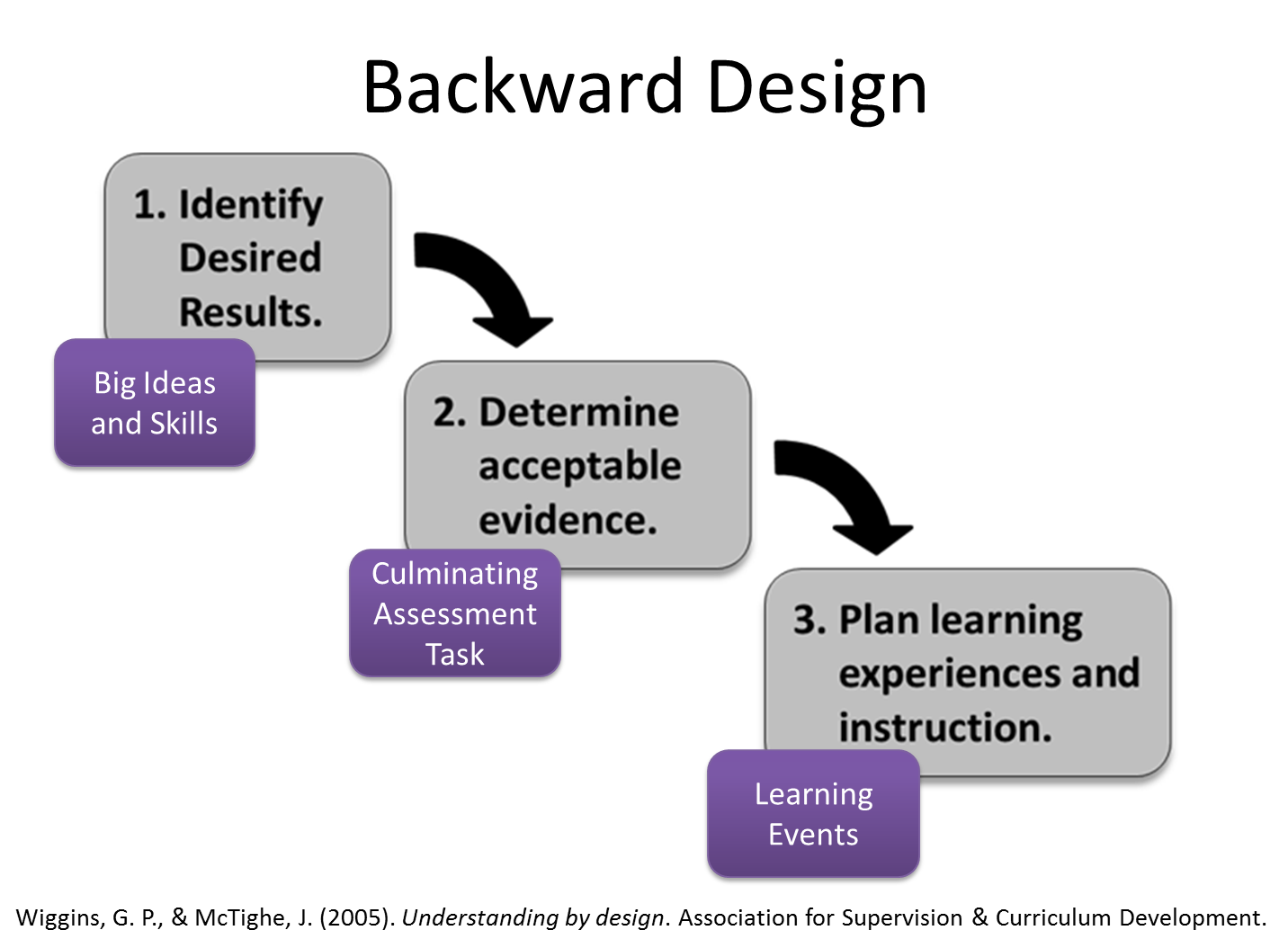
When designing more intentional and authentic assessments as opposed to multiple choice tests or easy content recall tests, it necessitates changing the whole unit as well. As Shepard (2000) notes, citing Graue (1993), "assessment and instruction are often...curiously separate in both time and purpose" (p. 291). By starting with what competencies I want students to develop, as opposed to what content I want them to know, assessment and teaching become inseparable.
My macromolecules investigation is a reflection of my attempt to move my Biology class away from just memorization by modifying and designing more intentional and skill-based assessments.
This assessment falls in a MYP 4/5 unit on Macromolecules and Enzymes. It is actually a modified version of a classic high school biology lab (The Trendy Science Teacher, n.d.). I used to do this lab as an activity during the unit, and then ask students rote memorization questions about the procedures, reagents etc on the end of unit summative. I have redesigned it now to be an assessment that allows them to demonstrate their knowledge and understanding of macromolecules and enzymes, but also the skills of critical thinking and engaging in argumentation based on evidence in addition to lab skills. By making these skills required on the end of unit summative, I now have to place a larger emphasis on them throughout the unit of teaching.
The premise of the assessment is that there is a food critic who was poisoned by a restaurant owner after he ate there. The food critic is found in his car having vomited up his last meal just before his passing. The students are tasked with analyzing the food critic's "vomit" for the presence of macromolecules to determine what macromolecules were present in his last meal. This requires them to independently run 4 separate experiments: Iodine testing for starches, Benedict's reagent for reducing sugars, Biuret's reagent for proteins and Ethanol testing for lipids. After they have their data, they are provided with information from police interviews in which the specialties and backstories of each suspected restaurant owner are described. Then, based on their data and the restaurant info, they must write or record a CER (claim, evidence, reasoning) responding to the question "Who killed the food critic?".
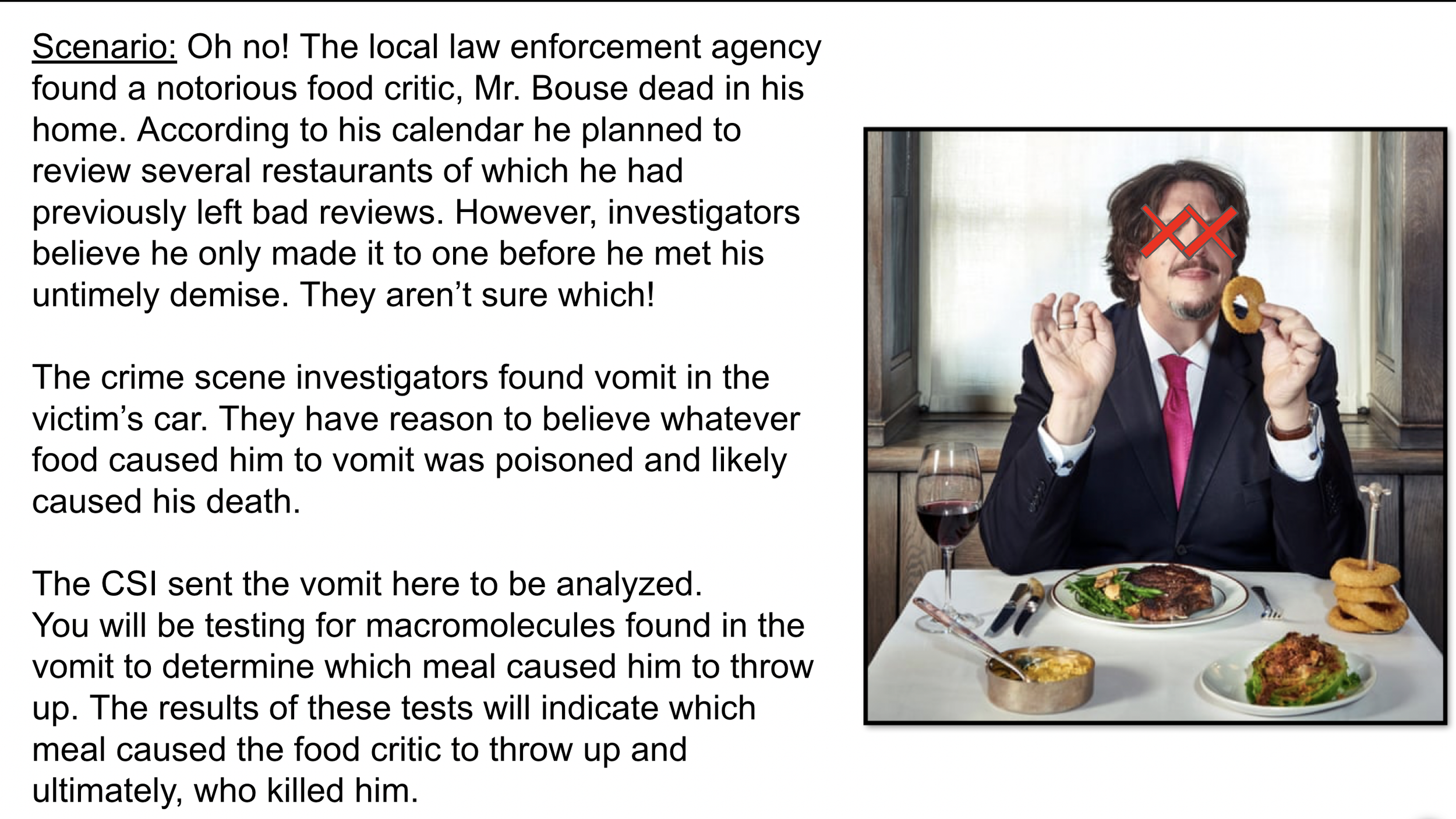
This assessment is far more authentic than the old ways I used to assess this knowledge. Previously, I would separate the "doing" of science from the "knowing" of science when in fact you cannot do science without knowing it. This reminds me of what Gee (2003) writes about video games and learning - video games are a valid assessment tool because by being able to do it, students demonstrate their knowledge. We do not need to give someone a separate written test on Pac-Man if they have already successfully navigated increasingly complex levels. In the same way, I can just have the students do the lab and draw a conclusion on their own, I do not need to then make them take another test on it.
The assessment also mirrors how science actually works. Scientists don't memorize facts in isolation and then apply them later instead, they use their knowledge to investigate questions, analyze evidence, and construct arguments. By positioning students as investigators solving a mystery, they experience science as it actually operates. More importantly, this kind of assessment is more equitable. Montenegro and Jankowski (2017) argue that when we assess all students in the same rigid way without considering their diverse ways of demonstrating learning, we end up privileging certain types of learners while creating unnecessary barriers for others. By offering multiple ways to demonstrate the same scientific competencies, I'm making sure the assessment actually measures what students know, not just their ability to perform in one specific format.
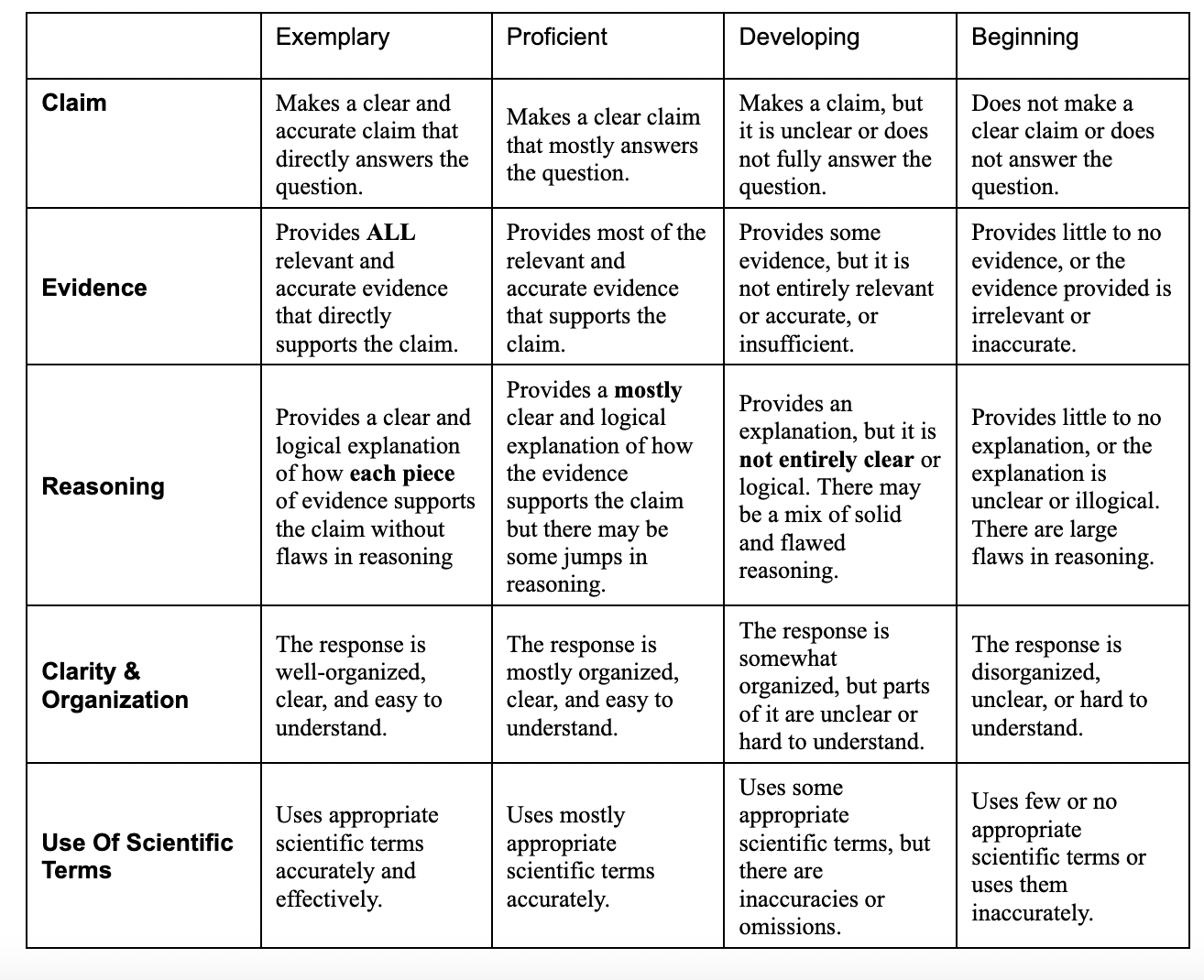
Some additional constraints I included in this assessment are allowing students choice in their method of response, inspired by UDL principles (specifically Consideration 5.1) (CAST, 2018). ELL students are permitted to write their responses in their best language, and all students have the choice of either writing or voice recording their response. Additionally, students can choose between a scaffolded CER format with separate spaces for the claim, evidence, and reasoning, or they can write a free style response. All responses are graded according to the same rubric. By being clear about what I expect: quality of scientific reasoning, appropriate use of evidence, and logical arguments, I am able to allow freedom in the way they demonstrate those competencies.
This redesign will fundamentally change how I teach this unit. Because lab skills, data analysis, and argumentation are now central to the summative assessment, I have to teach and practice these competencies throughout the unit, not just cover content and hope students can apply it. This has helped me see that when we assess what we truly value, not just content knowledge but scientific competencies, our teaching naturally shifts to support those outcomes. Assessment and instruction become, as they should be, inseparable.
References
CAST. (2018). Universal Design for Learning guidelines version 2.2: Checkpoint 5.1 - Use multiple media for communication. http://udlguidelines.cast.org/action-expression/expression-communication/multiple-media
Gee, J. P. (2003). What video games have to teach us about learning and literacy. Palgrave Macmillan.
Montenegro, E., & Jankowski, N. A. (2017). Equity and assessment: Moving towards culturally responsive assessment. National Institute for Learning Outcomes Assessment. https://www.utica.edu/academic/Assessment/new/OccasionalPaper29culturally%20responsive%20assessment.pdf
Shepard, L. A. (2000). The role of assessment in a learning culture. Educational Researcher, 29(7), 4-14. https://doi.org/10.3102/0013189X029007004
The Trendy Science Teacher. (n.d.). Macromolecules murder mystery lab. https://thetrendyscienceteacher.com/product/macromolecules-murder-mystery-lab/
Wiggins, G., & McTighe, J. (2005). Understanding by design (2nd ed.). Association for Supervision and Curriculum Development.
