Evaluating the EE Cafe
Every student in the International Baccalaureate Diploma Programme (IBDP) completes an Extended Essay (EE), a 4,000-word independent research project that functions like a mini dissertation. The research question is everything. Get it wrong, and spend months writing a textbook chapter instead of an argument.
This year, my school's first graduating DP cohort struggled with exactly that. Despite multiple supervisor meetings, every student submitted a research question that was descriptive and essentially unanswerable within the EE. So we designed an intervention: The EE Café. Students present their draft research questions to the school community: teachers, parents, and DP2 peers who have already completed the EE. The audience asks questions: Where will you find your data? What are you actually arguing? How would you know if you were wrong? The theory is that a broader room asks sharper questions than a single supervisor would.
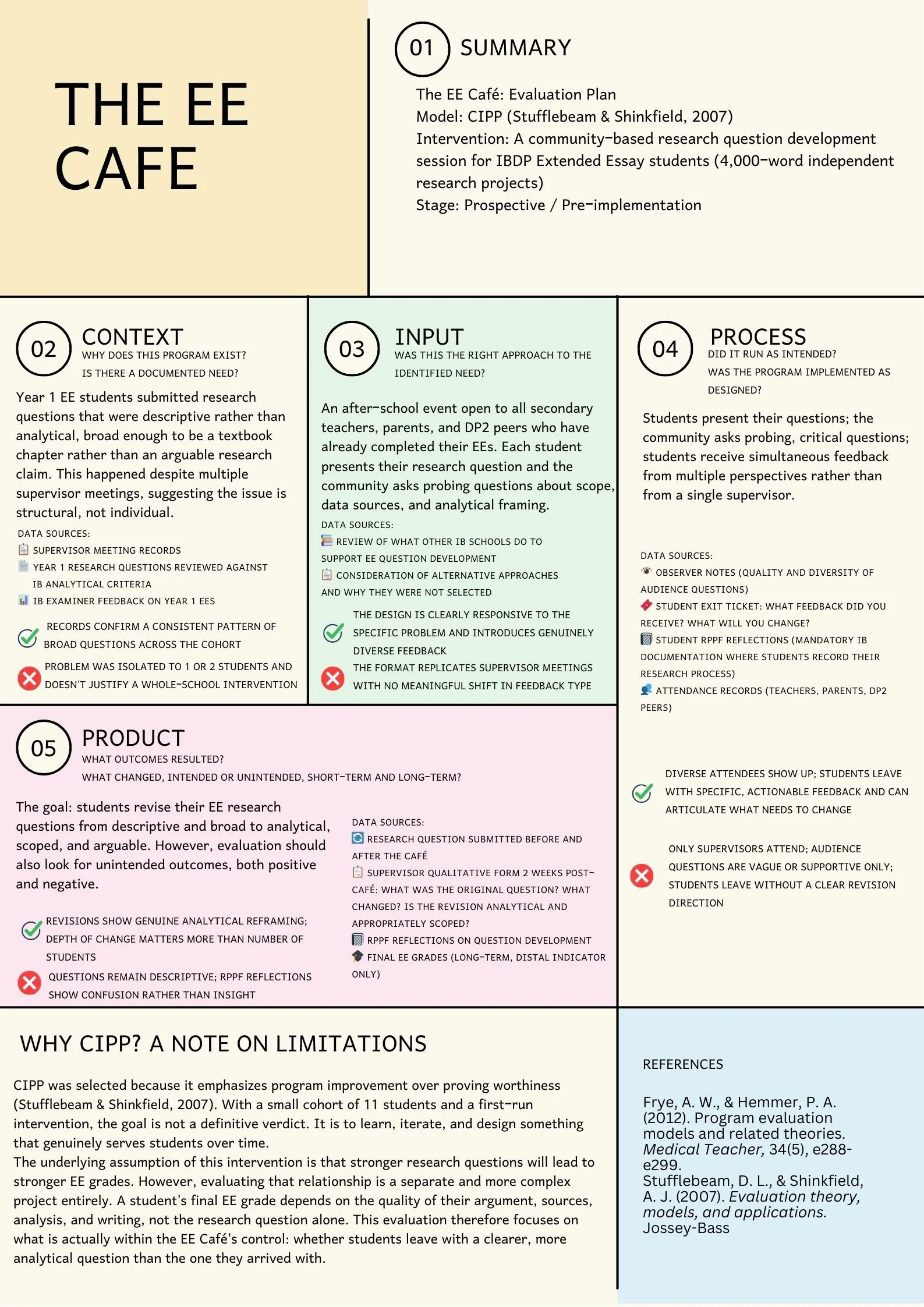
I chose the CIPP Evaluation Model to plan how I will know if it worked. According to Frye and Hemmer (2012), Stufflebeam intended CIPP evaluations to focus on program improvement instead of proving something about the program. Broad EE research questions are a widespread problem across IB schools, and I know the EE Café alone will not solve it. But it makes the EE process visible to the school community in a way that feels valuable, and with iteration I believe it can be designed to really serve students. CIPP gives me a framework for that iteration rather than just a verdict.
The evaluation maps across four dimensions: Context, Input, Process, and Product. Frye and Hemmer (2012) note that the first three support formative, improvement-focused evaluation while the Product component suits summative assessment, a structure that fits the EE Café perfectly. Effectiveness will be measured by depth of change in students' questions, not simply by how many students revise them.
Citations:
Frye, A. W., & Hemmer, P. A. (2012). Program evaluation models and related theories. Medical Teacher, 34(5), e288-e299.
Stufflebeam, D. L., & Shinkfield, A. J. (2007). Evaluation theory, models, and applications. Jossey-Bass.
